
In the evolving world of greenhouse horticulture, data is no longer a luxury. Using data from and in your greenhouse is essential! Whether you’re managing a high-tech tomato greenhouse or optimizing flower production, the key to sustainable success lies in greenhouse data. In this article, you will read the most important things you need to know about greenhouse data and how it can transform your cultivation strategy.
How greenhouse data transforms modern horticulture
What is greenhouse data?
Greenhouse data refers to the continuous flow of information collected from climate sensors, plant feedback systems, climate computers, cultivation software and other measuring instruments collection data from the greenhouse. Greenhouse data can includes parameters like temperature, humidity, CO₂ levels, PAR radiation, soil moisture, and even photosynthesis efficiency.
By analyzing this data, growers can make more informed decisions to optimize crop yield, save energy, and reduce risks. It’s not just about reacting, it’s about anticipating on the greenhouse data.
Why growers rely on smart greenhouse data
Greenhouse data offers growers a wide range of opportunities to improve efficiency, yield, crop quality, and sustainability. The examples below of using greenhouse data highlights just a few ways data can transform daily cultivation practices. From lighting to irrigation and CO₂ management, these cases illustrate why more and more growers rely on data-driven strategies in their greenhouses. And the possibilities go far beyond these examples.
- Optimized Lighting
Using PAR sensors and other sensors that measure light and data collected through plant feedback systems, growers can fine-tune artificial lighting to find the balance between efficiency and crop health. - Energy savings
By combining greenhouse data from sensors and plant feedback systems, growers can avoid unnecessary lighting and heating, significantly reducing energy costs. - Targeted irrigation
Soil moisture sensors integrated with climate data allow for precision irrigation, improving root health and reducing water waste. - CO₂ management
CO₂ sensors help you optimize photosynthesis without overexposing crops or staff to unsafe conditions.
MyLedgnd: all your greenhouse data in one platform
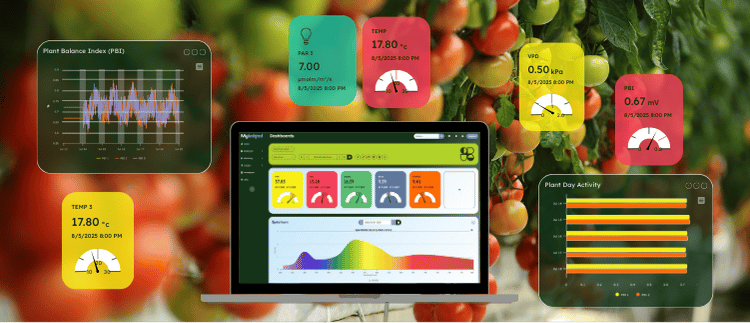
At Ledgnd, we developed MyLedgnd to centralize all greenhouse data in one powerful interface. Our philosophy is to remain brand-independent, which means MyLedgnd can integrate data from any supplier or device used in your greenhouse which can collect greenhouse data. Whether you work with sensors from different brands, climate computers, or advanced plant feedback systems, all data streams can be combined and visualized in one place; MyLedgnd.
MyLedgnd makes your greenhouse data visual, actionable, and mobile-friendly. By uniting multiple data sources, you are free to choose the technology that best fits your crop strategy, without being locked into one supplier.
Featured greenhouse data: Photosynthesis efficiency and plant feedback
In modern horticulture, growers have access to two main types of greenhouse data: climate data and plant feedback. Climate data shows what is happening in the greenhouse environment by collecting data such as temperature, humidity, CO₂, and light. Plant feedback, however, is an emerging innovation. Instead of only collecting greenhouse climate data, it measures how the plant itself responds to those conditions. This shift enables growers to move from steering the environment around the crop to steering based on the plant’s actual needs. By combining both approaches, growers gain a complete picture and take a major step toward smarter, more sustainable cultivation.
Greenhouse data from the climate
Climate data provides growers with valuable insights into the conditions inside the greenhouse. Parameters such as temperature, relative humidity, radiation, and CO₂ levels help to create a stable environment that supports plant growth. This type of greenhouse data is the foundation for every cultivation strategy, making it possible to steer irrigation, lighting, Co2 and other parameters.
Greenhouse data from the plant (plant feedback)
Plant feedback takes greenhouse data to the next level by measuring how the plant itself responds to its environment. With tools such as photosynthesis efficiency sensors, fluorescence monitoring, and leaf temperature measurements, growers can detect stress before it becomes visible. This enables proactive cultivation, where decisions are based not only on the climate but also on the actual needs of the crop.
Beyond collecting greenhouse data: real-time decision support
Greenhouse data is only valuable if it is visible, accessible, and available in real time.
Storing greenhouse data for later analysis can provide useful insights, but in daily cultivation it is often too late to act on yesterday’s cultivation problems. When greenhouse data is accessible and updated in real time in a platform like MyLedgnd, growers can immediately see how their crops and climate are behaving, and take action before plant stress or inefficiency causes damage.
Making greenhouse data visible in real time is the foundation of a truly data-driven precision cultivation strategy.
This real-time visibility transforms greenhouse data into a true management decision support system. Whether it involves adjusting lighting, irrigation, or climate settings, growers can respond proactively rather than reactively. The result is healthier crops, more efficient resource use, and a cultivation strategy that is constantly optimized based on what is happening inside the greenhouse right now.
The future of greenhouse data
Greenhouse data is no longer just a supporting tool, it is the foundation of modern, sustainable horticulture. By combining climate data and plant feedback in real time, growers can optimize every aspect of cultivation, from energy use to crop performance. At Ledgnd, we believe the future of greenhouse horticulture lies in turning data into action.
With MyLedgnd, you bring all your greenhouse data together in one clear, independent platform. This gives you the freedom to work with any sensor or supplier while still gaining a complete and actionable overview of your crop.