
How 2025 became the year of plant feedback, sustainability and collaboration
2025 was a year of contrasts for many growers: rising costs and stricter regulations, while at the same time more opportunities than ever to gain control of the crop using data. At Ledgnd, the year was shaped by one central question as well: how do you translate all greenhouse data into clear overviews, actionable steering information and more sustainable choices?
We look back on the past year with Ramon van de Vrie, founder and Chief Commercial Officer of Ledgnd. “We see that data alone is no longer enough,” Ramon explains. “Growers don’t need yet another chart, but systems that help them make choices: what matters today, where the biggest gains are and what can be done more sustainably without compromising the crop.”
Sustainability: between ambition and practice
Alongside all technological developments, the pressure on growers to become more sustainable continued to increase in 2025. The Dutch government aims for climate-neutral greenhouse horticulture by 2050, while Glastuinbouw Nederland has set the ambition of achieving zero CO₂ emissions by 2040. “Growers are caught between ambition and practice,” Ramon says. “Everyone understands why sustainability is necessary, but in the greenhouse it also has to make sense: financing, technology, feasibility and ultimately the crop that has to perform.”

In this, data and plant feedback play an increasingly important role. Not as a report after the fact, but as a tool to steer more effectively in the moment.
“With good data and plant feedback, you can see what your crop actually needs and where easy gains can be made,” Ramon explains. “That’s when steering on plant feedback becomes concrete: you can test step by step what happens when you do less, instead of growing purely on intuition. In a way, you give your crop a voice. Plant feedback helps you clearly understand what the plant truly needs and allows you to steer based on facts.”
Innovations: from measurement to actionable steering
Against that backdrop, 2025 was also a year of targeted product innovations at Ledgnd within MyLedgnd, the data platform for greenhouse horticulture. Not as a collection of standalone “nice to have” features, but as concrete building blocks that make the step from measuring to acting smaller and bring you closer to the plant than a measurement box alone ever could.
“The question is increasingly less: which technology can I add?” Ramon says. “And more often: how can I apply this effectively in the greenhouse tomorrow? In other words: how does an additional measurement become directly useful in your daily decisions?”
Ramon points to three developments that stood out for him: the CF2GO from PhenoVation, the development and integration of the Aranet Light Spectrum sensor, and the integration of KNMI weather data.
Integration of the CF2GO photosynthesis sensor
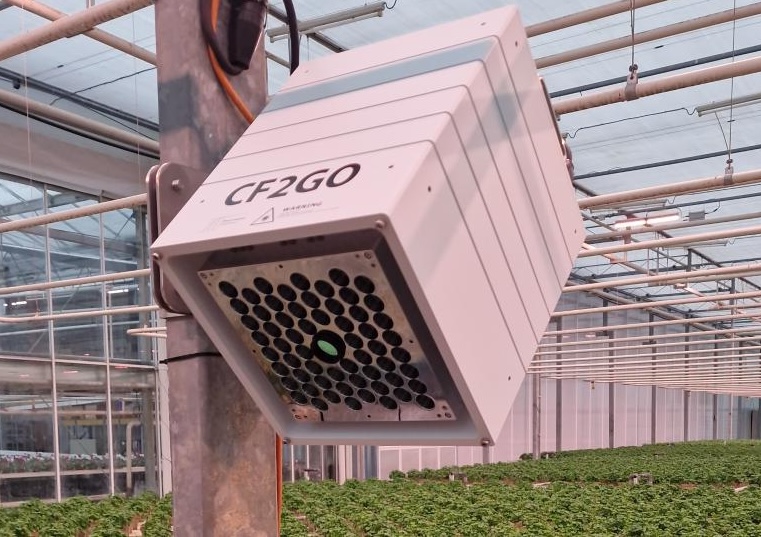
With the integration of the CF2GO from PhenoVation, growers can see in MyLedgnd how efficiently the plant converts light into growth.
“You don’t just see that you are lighting,” Ramon says, “you also see how the plant responds to that light. This makes discussions about lighting hours, intensity and timing much more concrete, especially when you are looking for ways to save energy without sacrificing production. In that process, plant feedback is a reliable guide.”
Aranet Light Spectrum sensor
In 2025, the new light spectrum sensor also found its way into the MyLedgnd platform. This makes not only the amount of light visible, but also the distribution across different wavelengths.
“At a time when LED strategies are becoming increasingly sophisticated, it’s important not to think only in terms of micromoles or PAR,” Ramon explains. “With the spectrum sensor, you can better assess what the light is actually doing to the plant, and with a controllable fixture you can give the crop exactly the light colour it needs.”
“You see that reflected in practice as well,” Ramon adds. “For example, with a cucumber grower you can more objectively assess whether an adjusted spectrum truly contributes to generativity and plant balance, instead of steering solely on light sum. And in chrysanthemum, where far-red light is often used to steer elongation and bud or flower development, spectrum data helps make the effect of such a ‘far-red recipe’ visible and reproducible.”
KNMI weather data linked to the greenhouse
By directly linking KNMI weather forecasts to greenhouse data, growers gain a clearer picture of the interaction between the outside environment and the greenhouse. By displaying KNMI weather data directly in MyLedgnd alongside your greenhouse measurements, you can see not only what is happening now, but also what is coming next. Forecasted radiation, temperature and cloud cover are directly connected to your own greenhouse and plant data.
Plant and climate in one view
Where the focus used to be mainly on climate and technology, the plant itself is now taking a much more central role. This is not a shift driven by Ledgnd alone, Ramon emphasises, but a broader movement he sees across the sector.
“What we saw most clearly in 2025 is that growers are becoming more curious about how the plant responds,” he explains. “Not just: ‘What did I set in my climate computer?’, but also: ‘What does the plant do with that?’ This data is delivering increasingly valuable insights that growers can turn into real gains. As a result, plant feedback has become a fixed part of daily steering information in many cultivation teams.”
By bringing plant measurements, climate data and strategies such as lighting and CO₂ together in one overview, new conversations emerge. Why does the plant respond differently on certain days than expected? Where do we see the first signals of stress or untapped growth potential?
“I always like hearing a grower say: ‘Using data, I now make different choices. I dare to adjust my lighting or CO₂ strategy because the plant feedback in MyLedgnd shows that the plant is coping just fine,’” Ramon says. “That’s when data-driven cultivation becomes very concrete: turning plant data into a clear strategy.”
Looking ahead
Aan het eind van het jaar kijkt Ramon vooral vooruit. De druk en manieren om winst te verhogen zal de komende jaren niet afnemen en de hoeveelheid data in de kas ook niet. De kunst is om die twee bij elkaar te brengen en de teler verder te helpen.
“Als ik terugkijk op 2025, dan zie ik vooral dat data pas waarde krijgt als het helpt om betere gesprekken te voeren,” besluit hij. “Gesprekken over teelt, over risico’s, maar ook over wat er wél mogelijk is richting fossielvrij en nul-emissie. Als data en plantfeedback daarbij zorgen voor inzicht, overzicht en gerichte keuzes, dan heb je pas echt wat aan al die metingen in de kas.”

New articles
Ledgnd x HortiSoccer World Cup Pool 2026 brings the horticultural industry together
With the launch of the renewed Ledgnd x HortiSoccer World Cup Pool 2026, people working across the horticultural industry once again get the chance to compete against each other during the FIFA World…
GreenTech Amsterdam 2026
From 9 to 11 June 2026, RAI Amsterdam will be all about GreenTech, the international trade fair for the horticulture sector. Professionals from around the world will come together to share knowledge a…
HortiContact 2026 Recap
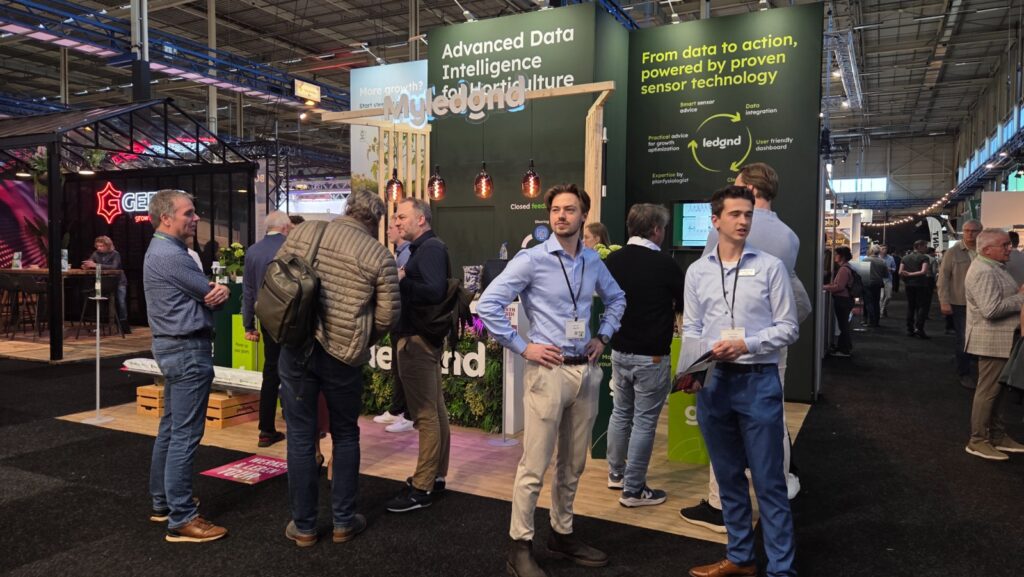
Ledgnd Reflects on a Successful Edition of HortiContact 2026 HortiContact 2026 at Evenementenhal Gorinchem once again served as a meeting place for the Dutch greenhouse horticulture sector. Ledgnd loo…
Read more
Ledgnd x HortiSoccer World Cup Pool 2026 brings the horticultural industry together
With the launch of the renewed Ledgnd x HortiSoccer World Cup Pool 2026, people working across the horticultural industry once again get the chance to compete against each other during the FIFA World…
GreenTech Amsterdam 2026
From 9 to 11 June 2026, RAI Amsterdam will be all about GreenTech, the international trade fair for the horticulture sector. Professionals from around the world will come together to share knowledge a…
HortiContact 2026 Recap
Ledgnd Reflects on a Successful Edition of HortiContact 2026 HortiContact 2026 at Evenementenhal Gorinchem once again served as a meeting place for the Dutch greenhouse horticulture sector. Ledgnd loo…
Do you want to know more?
Interested in what Ledgnd can do for you? Leave your phone number, and we will contact you as soon as possible for a non-binding informational conversation